Heat Transfer · Materials
Purposefully Aligned Radial-Basal-Plane Graphite Tubes
Graphite is among the most thermally conductive engineering materials at commercial scale — basal-plane thermal conductivity of natural flake graphite is 1,500–1,800 W/m·K, roughly four times copper — but only along one crystallographic direction. Target applications include chemical-process heat exchangers, AI-accelerator cold plates, and spacecraft radiator panels. Graphite is among the most thermally conductive engineering materials at commercial scale — basal-plane thermal conductivity of natural flake graphite is 1,500–1,800 W/m·K, roughly four times copper — but only along one crystallographic direction.

Perpendicular to the basal plane, conductivity collapses to 5–8 W/m·K. Current commercial impervious-graphite heat-exchanger tubes (Mersen, SGL Carbon, CG Thermal, Graphite India — a $250–300M annual global market) use randomly oriented graphite grains, which average out to 50–90 W/m·K through the wall, well below copper. We developed a manufacturing process that aligns the basal planes of graphite radially with respect to the tube axis during the forming-and-cure step, producing tubes with wall-normal thermal conductivity of 400–1,700 W/m·K depending on processing tier — five to thirty times the prior-art baseline, one to four times copper, at one-quarter copper's density. The process is drop-in compatible with existing impervious-graphite manufacturing — same extruders, baking furnaces, graphitization furnaces, and impregnation autoclaves. Target applications include chemical-process heat exchangers, AI-accelerator cold plates, and spacecraft radiator panels.
Mersen · SGL Carbon · CG Thermal | Drop-In Manufacturing | Provisional Filed
Open for LicensingAI Compute · Thermal Management
Chiller and Cooling Tower Free Direct-Liquid Cooling for AI Datacenters
For NVIDIA's Vera Rubin generation and the AI accelerators that follow, the die-to-coolant temperature drop determines whether a datacenter requires mechanical chiller and cooling tower systems. Conventional cold-plate-plus-thermal-interface-material stacks lose 20–30 °C across both. Even NVIDIA's purpose-engineered Vera Rubin cooling block — the current state of the art — leaves 20–25 °C on the table. The 5 Layers Deep integrated heat spreader (IHS) collapses the drop to roughly 12 °C.
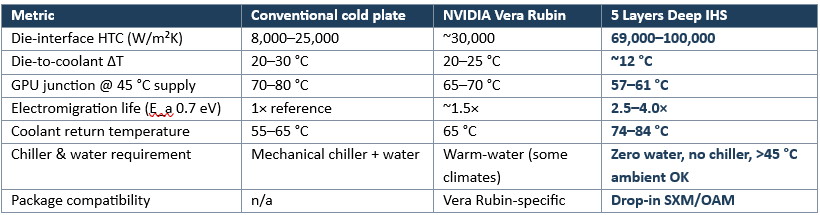
The implications cascade. With coolant supply at 45 °C and return at 74–84 °C, the rejection loop runs on dry coolers alone — no chillers, no makeup water, no evaporative loss — even at >45 °C ambient. The same thermal margin, redirected, holds GPU junction temperatures 13–19 °C below conventional operation, where the Arrhenius dependence of electromigration and gate-dielectric breakdown extends silicon lifetime by 2.5–4× per stack. The IHS is a drop-in replacement for SXM and OAM sockets — no host-board or system redesign required. Cooling-infrastructure CapEx, water consumption, and parasitic facility load drop by 30–40% per megawatt of compute, with the silicon-lifetime extension compounding on top.
NVIDIA · AMD · Hyperscalers | Chiller-Free Southwest Datacenters | 2.5–4× Silicon Lifetime
Strategic Partners WelcomePharmaceutical · Specialty Chemicals
Pharma-Grade Phosphoric Acid via Solvent-Free WPA Purification
Solvent-free purification of wet-process phosphoric acid to compendial pharmaceutical grade meeting USP/FCC specifications for arsenic, lead, heavy metals, fluoride, sulfate, and chloride. Sidesteps the thermal-process and solvent-extraction routes that dominate today's pharma- and food-grade acid markets and creates a domestic supply path independent of imported solvent-purified product.
USP/FCC Grade | Pharma & Food Excipient | Domestic Supply Independence
Strategic Partners WelcomeEnergy Storage · EV
Dopant-Grade Phosphoric Acid for LXFP Battery Cathode Synthesis
Precise M-site doping stoichiometry in LiMₓFe₁₋ₓPO₄ cathodes requires structural sulfate-zero precursor chemistry. WPA-origin acid introduces sulfate substitution at lattice sites that degrades electrochemical performance. The only domestic route to LXFP dopant-grade acid.
Tesla · LG · Panasonic | LXFP Cathode | IRA Compliance
Strategic Partners WelcomeSemiconductor · Process Chemistry
Structural Sulfate-Zero Phosphoric Acid for 2nm Semiconductor Fabrication
The only commercially viable production route for ultra-high-purity phosphoric acid meeting the complete 20-impurity ppt-class specification required for gate-all-around nanosheet transistor fabrication. The structural sulfate-zero distinction, defined by production provenance rather than analytical threshold, creates a categorical market divide that no amount of WPA purification can cross.
CHIPS Act | Domestic Supply Chain | TSMC · Intel · Samsung | 18 Provisionals
Strategic Partners WelcomeCritical Materials · Environmental
Individual REE Recovery & Ra-226 Vitrification from Phosphogypsum
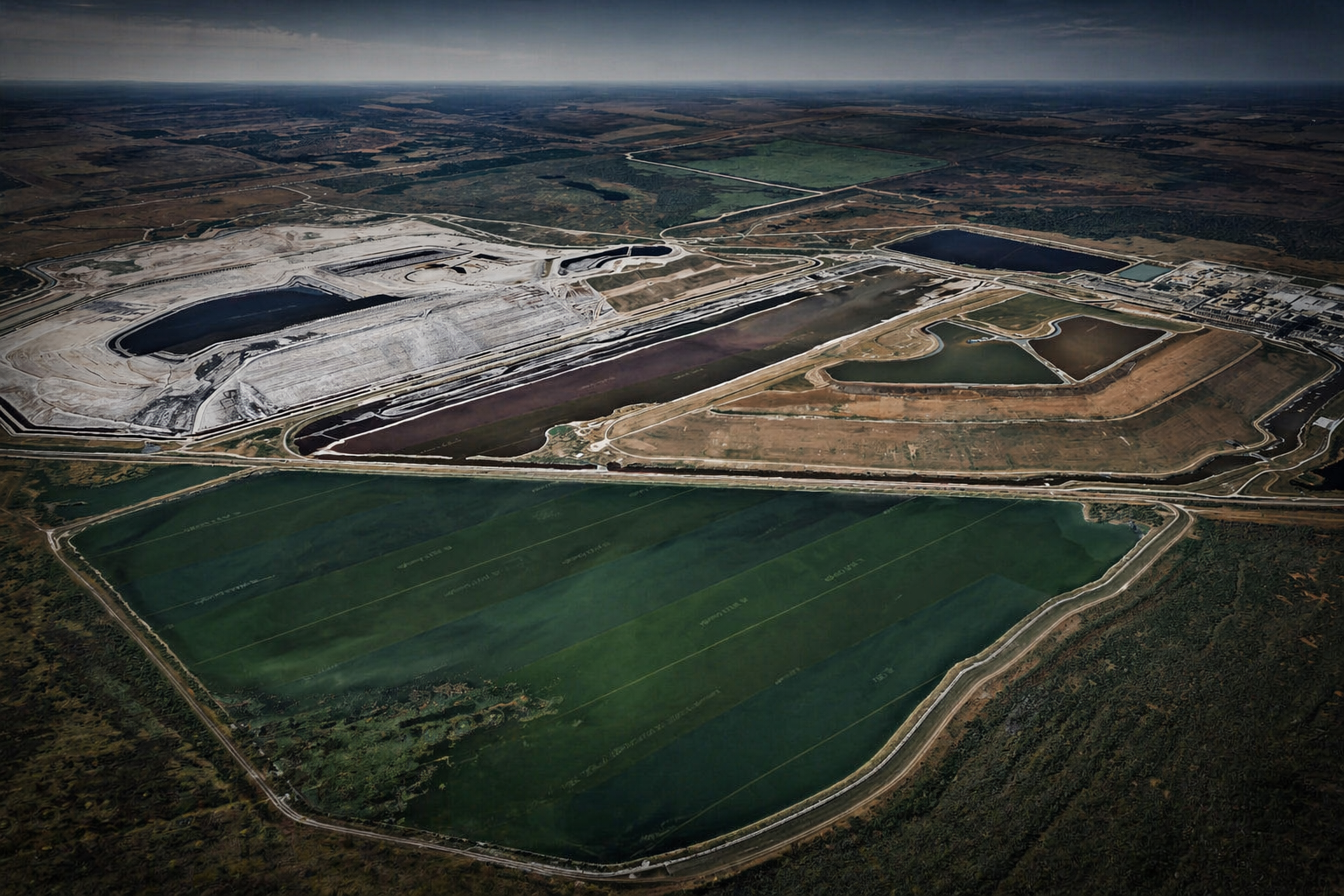
The only U.S. patent application combining individual rare earth element separation with Ra-226 vitrification from Florida's 1+ billion tonne phosphogypsum stockpile. Solvent-free. Converts a $4B+ regulatory liability into a domestic REE supply chain.
DOE Critical Materials | Ra-226 Management | Bone Valley
Open for Licensing%20(1).png)
%20(1).gif)
![[background image] image of plumbing blueprints](https://cdn.prod.website-files.com/69cf194065c9e4130eff1154/69ea7c3bb33c21146fcb358d_phosphoric%20acid%20etching%20SiO2.png)